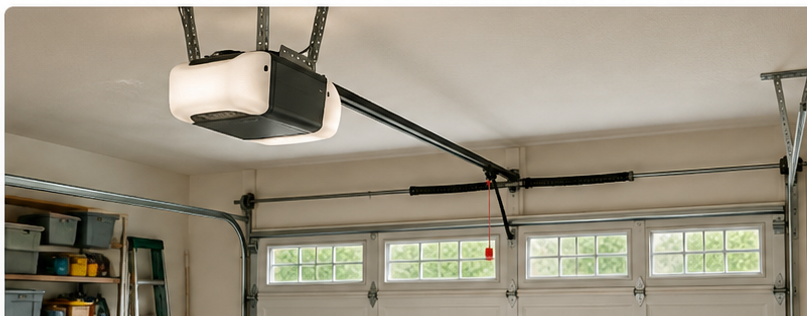
Overview
The garage door opener is only one part of the complete garage door system. The opener provides powered movement and controls, while springs counterbalance the weight of the door and cables, rollers, tracks and hinges guide its movement.
That distinction matters because a symptom that looks like an opener failure may actually begin with the door itself. Repeatedly operating an opener against a damaged, jammed or unusually heavy door can create additional problems.
Common garage door opener problems
- Nothing happens: power, controls, wiring, lock settings or the opener itself may be involved.
- Motor runs but the door does not move: the trolley may be disconnected, a drive component may have failed, or the door may have a mechanical problem.
- Door starts down and reverses: safety sensors, obstructions, travel settings or door resistance may be involved.
- Remote works intermittently: batteries, programming, interference, antenna or receiver issues are possibilities.
- Opener is unusually noisy: worn drive components, mounting hardware or a problem elsewhere in the door system may contribute.
- Door stops before fully opening or closing: travel settings, force sensing, obstructions or mechanical resistance may need evaluation.
Is the problem the opener or the garage door?
A useful first question is whether the door itself can move safely and normally. A broken spring can make a door extremely heavy even though the opener motor still runs. Damaged rollers, cables or tracks can also create resistance that the opener was not designed to overcome.
Garage door opener drive types
Often selected for quieter operation, especially when living space is near or above the garage.
A common, proven design that uses a metal chain. Operation may be more noticeable than some belt systems.
Mounts beside the door rather than on the ceiling on compatible door systems, freeing overhead space.
| Type | Potential advantages | Considerations |
|---|---|---|
| Belt drive | Quieter operation; smooth movement | Often priced above basic chain-drive models |
| Chain drive | Widely available; familiar design | Can transmit more vibration and noise |
| Screw/direct-drive designs | Design may use fewer traditional drive components | Availability and maintenance requirements vary by manufacturer |
| Wall-mount | Ceiling clearance; clean overhead space | Requires a compatible door and installation configuration |
Features to consider when choosing an opener
- Appropriate lifting application: opener selection should match the door system and manufacturer requirements.
- Battery backup: can allow limited powered operation during certain power outages on equipped systems.
- Smart connectivity: compatible models may provide app control, status alerts and activity history.
- Lighting: integrated LED lighting can improve garage visibility.
- Keypad and remote options: consider the number of users and access methods needed.
- Security features: modern systems may include rolling-code technology and monitoring features.
- Noise level: especially important when bedrooms or living spaces adjoin the garage.
Repair or replace the garage door opener?
Age alone does not determine the answer. Consider the specific failure, repair history, parts availability, safety features, reliability and the cost of repair compared with a new properly matched opener.
When the unit is otherwise reliable and the problem is an available, serviceable component.
When failures repeat, important parts are unavailable, the unit lacks desired safety or access features, or repair cost approaches replacement cost.
A new opener will not correct a broken spring, damaged cable, binding track or other mechanical door problem.
Safety considerations
Garage door openers move a large, heavy door. Keep the opening clear during operation and follow the manufacturer's instructions for testing photo-eye sensors and automatic reversal features.
Do not bypass safety devices. Do not attempt to adjust springs, lifting cables or other high-tension door components while troubleshooting an opener.
When to call a garage door professional
- The door is unusually heavy, crooked, jammed or off track.
- A spring or lifting cable is broken or damaged.
- The opener repeatedly reverses after basic obstruction and sensor checks.
- The motor runs but the door does not move normally.
- Safety reversal features do not work as specified.
- There is burning odor, visible electrical damage or repeated breaker trips.
- You are considering a new opener and need to confirm compatibility with the existing door.
Garage door opener FAQs
Why does my garage door opener run but the door does not move?
Possible causes include a disconnected trolley, failed drive component or a mechanical door problem such as a broken spring. Avoid repeatedly operating a door that appears damaged or unusually heavy.
How long do garage door openers last?
Service life varies with the model, usage, maintenance, environment and installation. Reliability, safety features, parts availability and repair history are usually more useful than age alone.
Should I repair or replace my opener?
Compare the specific repair, unit age, parts availability, features, repair history and replacement cost. Also confirm that the garage door itself is operating correctly.
Can I install a smart garage door opener?
Many current openers offer connected features, but compatibility, Wi-Fi requirements, door configuration and installation needs vary by product.